
- June 15, 2026
- varunam
- 0

- M.B.B.S.
- M.S. Orthopaedics
- Fellow in Knee and Hip Replacement, Mumbai
- Fellow In Knee and Hip Surgery, Germany
- Fellow in Knee and Hip Surgery, NHS, Singapore
- Fellowship in Complex and revesion knee and Hip replacement, London, Lancaster, UK
“Robotic knee replacement” has become one of the most prominently marketed surgical technologies in Indian orthopaedics over the past 5 years. Every major hospital chain advertises it. Every brochure mentions precision, accuracy, and superior outcomes. Patients arrive at consultation specifically asking for robotic surgery, often having decided before they’ve even understood what their actual knee problem is.
This post is an honest comparison from a surgeon’s perspective. Robotic-assisted surgery has genuine benefits in specific situations. It also has significant marketing-driven hype around it. Both deserve clear discussion.
What "Robotic Knee Replacement" Actually is?
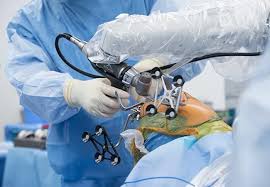
Important to clarify upfront: there is no robot operating on the patient. The surgeon performs the surgery. The “robot” is a sophisticated cutting and positioning guidance system a robotic arm that helps the surgeon make bone cuts with high precision based on a 3D plan generated from the patient’s CT scan or intra-operative mapping.
The major systems used in India include MAKO (by Stryker), ROSA (by Zimmer Biomet), VELYS (by DePuy/Johnson & Johnson), and CUVIS (Indian-made, by Meril). They differ in technical details but share the same basic premise: surgeon expertise + computer guidance for bone cuts and implant positioning.
This is distinct from “computer-assisted” or “navigation” knee replacement — older technology that provides positioning feedback without the robotic arm.
What Robotic Assistance Genuinely Helps With?
Three real benefits, supported by published evidence:
1. More Accurate Bone Cuts and Implant Positioning
Especially in cases with significant deformity, asymmetric arthritis, or complex anatomy. The robot’s planning system uses the patient’s specific 3D bone geometry rather than standardised reference points.
2. Less Soft-Tissue Disruption in Some Cases
Because the system can plan around critical structures, the surgical exposure may be smaller, with less collateral damage to surrounding tissues.
3. Particularly Valuable in Partial Knee Replacement (PKR/UKR)
The small implants of PKR require very precise positioning small positioning errors significantly affect long-term outcomes. Here, robotic assistance offers genuine advantage.
Where the Marketing Outpaces the Evidence?
Several common claims about robotic surgery don’t hold up well under scrutiny:
“Robotic surgery means faster recovery.”
Published comparative studies show essentially identical recovery timelines between well-performed robotic and conventional knee replacement. The marketing claim of “back to walking in 1 day” is true — but it’s also true for conventional surgery. Early mobilisation depends on anaesthesia protocols and rehabilitation, not on whether the surgery was robotic.
“Robotic surgery means less pain.”
Pain levels at 24 hours, 1 week, and 6 weeks are statistically similar between robotic and conventional groups in most published series.
“Robotic implants last longer.”
The longest-term outcome studies (10-15 years) are not yet mature enough to make this claim definitively. Theoretical biomechanical arguments suggest better alignment may improve long-term wear; clinical confirmation is still pending.
“Only robotic surgery achieves precise alignment.”
A high-volume conventional knee surgeon routinely achieves alignment within the same tolerance as robotic systems. The robot helps surgeons of varying experience achieve consistent results; it doesn’t make a skilled surgeon meaningfully more accurate.
Wondering if your case actually needs robotic assistance?
Send Dr. Utsav your knee X-rays get a clear answer on whether your specific anatomy benefits from robotic surgery, or whether conventional gives equivalent results.
The Honest Comparison
| Factor | Robotic | Conventional (skilled surgeon) |
|---|---|---|
|
Surgical accuracy |
Slightly better (1-2 degree
improvement on average) |
Excellent in experienced
hands |
|
Surgery duration |
90-120 minutes (longer setup) |
60-90 minutes |
|
Hospital stay |
Same |
Same |
|
Pain levels |
Same |
Same |
|
Recovery timeline |
Same |
Same |
|
1-year function |
Statistically similar |
Statistically similar |
|
5-year outcomes |
Statistically similar |
Statistically similar |
|
15-year outcomes |
Not yet confirmed |
Well-documented at 90%+ survival |
|
Best for complex cases |
Genuine advantage |
Requires more surgeon
experience |
|
Best for partial knee
replacement |
Clear advantage |
Possible but harder |
|
Cost premium in
Nagpur |
+₹80,000 to ₹1,50,000 |
Standard pricing |
When Robotic Assistance Genuinely Adds Value
Choose robotic surgery if:
• Your knee has significant deformity (severe bow-leg or knock-knee beyond 15-20 degrees)
• You’re a candidate for partial knee replacement
• You have unusual bone anatomy (post-traumatic, congenital, post-osteotomy)
• The technology is available at the same surgeon and same hospital you’d choose anyway
• The cost premium is acceptable to you
When Conventional Surgery Is Equally Right?
Choose conventional surgery (with a high-volume surgeon) if:
• You have standard arthritis without major deformity
• The cost premium for robotic surgery is significant for your budget
• The robotic system isn’t available at the surgeon you most trust
• You’re choosing primarily based on what the surgeon does most often
When Conventional Surgery The Most Important Variable Isn't the TechnologyIs Equally Right?
In published surgical outcomes research, the single largest predictor of long-term success in knee replacement is annual surgical volume of the surgeon not whether they used a robot. Surgeons performing 100+ knee replacements per year have outcomes that significantly outperform those doing 20-30 per year, regardless of technology used.
If a hospital offers robotic surgery but performs only 50 joint replacements per year across all surgeons, that’s a worse choice than a hospital doing 500 conventional joint replacements per year with senior, fellowship-trained surgeon
The Bottom Line
Robotic knee replacement is good technology in skilled hands. It’s not magic. It’s not significantly different from well-performed conventional surgery in most outcomes that matter to patients. It’s most valuable in complex cases and partial knee replacement — and least valuable in straightforward arthritis cases.
Choose the surgeon first, then have a frank conversation about whether your specific case benefits from robotic assistance. If the technology genuinely helps, the cost premium is reasonable. If it doesn’t, you’ve saved ₹1 lakh that could go toward a better implant, better post-op care, or simply remain in your pocket.
FAQ
Dr. Utsav uses navigation and computer-assisted techniques where clinically beneficial, and refers patients to robotic platforms when their specific anatomy genuinely benefits. The decision is based on the patient’s case, not on marketing.
Most insurance policies cover the surgery itself but cap reimbursement at standard knee replacement rates. The
robotic technology premium (₹80,000-₹1,50,000) typically becomes an out-of-pocket expense.
Generally no Ayushman package rates don’t cover the robotic technology premium. Some hospitals allow top-
up payment to upgrade an Ayushman surgery to robotic.
Statistical evidence on complication rates is mixed. Some studies show modest improvements in alignment-
related complications; rates of infection, blood clots, and other complications are similar
The MAKO system received FDA approval in 2015; widespread adoption in India began around 2018-
2020. The technology is now well-established, though 15-year outcome data is still maturing.
Get a Clear Opinion on Your Case
Dr. Utsav reviews every patient’s anatomy individually and recommends robotic or conventional surgery based on what actually benefits the patient not based on what generates more revenue.
Call: +91 7447799000
WhatsApp: Start conversation