
- June 16, 2026
- varunam
- 0

- M.B.B.S.
- M.S. Orthopaedics
- Fellow in Knee and Hip Replacement, Mumbai
- Fellow In Knee and Hip Surgery, Germany
- Fellow in Knee and Hip Surgery, NHS, Singapore
- Fellowship in Complex and revesion knee and Hip replacement, London, Lancaster, UK
Hip replacement is one of the most successful operations in modern medicine. For patients with severe hip arthritis, AVN, fractures of the femoral neck, or other end-stage hip conditions, hip replacement offers something rare: near-complete restoration of pain-free function. The 10-year satisfaction rates for hip replacement are higher than for almost any other elective surgery.
This guide covers what you need to know if you’re considering hip replacement in Nagpur when it’s needed, what the surgery actually involves, recovery realities, costs, and how to make an informed surgeon choice.
When Hip Replacement Becomes the Right Decision?
The right time for hip replacement is not “as late as possible” a common misconception. The right time is when:
- Pain is significantly affecting daily activities (walking, sleep, climbing stairs, putting on shoes)
- Conservative treatments (physiotherapy, weight management, anti-inflammatory medications, viscosupplementation injections, lifestyle modification) no longer provide acceptable relief
- Imaging confirms structural joint damage that matches your symptoms
- Quality of life has measurably deteriorate
Common reasons for hip replacement in Nagpur:
- Osteoarthritis of the hip – wear-and-tear arthritis, most common in patients 60+
- Avascular necrosis (AVN) – increasingly common in patients 30-50, particularly post-COVID and post-steroid use
- Hip fractures in elderly patients (femoral neck fractures)
- Rheumatoid and other inflammatory arthritis
- Failed previous hip surgery (revision hip replacement)
- Developmental dysplasia in adults
Surgical Approaches: What "Anterior" and "Posterior" Mean
Hip replacement can be performed through several different approaches, each with trade-offs:
- Posterior approach — the traditional and most commonly used worldwide. Excellent visualisation, applicable to all hip cases, slightly higher dislocation risk in the early recovery period (manageable with appropriate post-op precautions).
- Anterior approach — performed from the front of the hip, through a natural muscle interval. Less muscle disruption, faster early recovery, lower dislocation risk. Slightly more technically demanding for the surgeon; not suitable for all body types or hip anatomies.
- Lateral approach — somewhere between anterior and posterior; less commonly used now.
- Minimally invasive variants of any approach – use smaller incisions and less soft-tissue dissection.
For most patients, the choice between approaches matters less than the experience and judgment of the surgeon. A skilled surgeon using their preferred approach will give better outcomes than an inexperienced surgeon using a “trendy” approach.
What the Surgery Actually Involves?
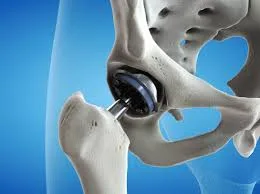
Total hip replacement takes 60-90 minutes for a primary case. The diseased ball and socket of the hip joint are removed and replaced with implant components:
- Acetabular cup – a metal shell that replaces the socket, lined with polyethylene or ceramic
- Femoral stem – a metal stem inserted into the thigh bone (femur)
- Femoral head – a ceramic or metal ball that attaches to the stem and articulates with the cup
Implant material choices matter:
- Metal-on-polyethylene – standard, well-proven, suitable for most patients aged 65+
- Ceramic-on-polyethylene – ceramic ball with plastic liner; lower wear, suitable for younger active patients
- Ceramic-on-ceramic – both surfaces ceramic; lowest wear, suitable for very young active patients (under 50); slight risk of squeaking
- Metal-on-metal – largely abandoned due to concerns about metal ion release; not used today
For a typical patient in their 60s, metal-on-polyethylene or ceramic-on-polyethylene with a high-quality cross-linked polyethylene liner gives 20-25 year implant life.
Considering hip replacement?
Send Dr. Utsav your hip X-rays or MRI for an initial assessment — when surgery is needed, which approach fits your case, and what implant is right for your age and activity level.
WhatsApp Now → +91 7447799000
Recovery: What Most Patients Experience?
Hip replacement recovery is often faster and easier than knee replacement recovery. Most patients describe:
Day 1-3 in hospital: Walking with walker support, beginning physiotherapy. Pain typically well-controlled.
Week 1-2 at home: Walking with walker, then walking stick. Light home activities. Specific positional restrictions (no crossing legs, no extreme bending — these are critical to prevent dislocation in the first 6 weeks).
Week 3-4: Walking with stick outdoors. Most patients return to office-based work or driving an automatic car (left hip operated allows driving sooner; right hip needs more time).
Week 6-8: Walking unassisted. Most positional restrictions lift. Stationary cycling, swimming, gentle yoga become possible.
Week 12 onwards: Full functional recovery. Walking long distances, light fitness activities, social and travel activities all comfortably possible.
Month 6: Continued biological “settling” of the implant. Most patients describe this point as the new normal.
The Cost Picture in Nagpur
| Payment mode | Single hip replacement |
|---|---|
|
Ayushman Bharat |
₹85,000-₹1,10,000 |
|
Cash, standard implant |
₹1,90,000-₹2,90,000 |
|
Cash, ceramic-on-polyethylene |
₹2,60,000-₹3,50,000 |
|
Cash, ceramic-on-ceramic |
₹3,20,000-₹4,30,000 |
|
Insurance cashless |
Depends on policy; typically ₹2,00,000-₹3,50,000 |
For bilateral hip replacement (both hips in one sitting, suitable for medically fit patients), add approximately 60-70% to single-hip costs.
Why Surgeon Choice Matters More for Hip Than Knee?
Hip replacement is generally a more technically demanding surgery than knee replacement. Variables that surgeons manage during the procedure include leg length restoration, joint stability, soft-tissue tension and component positioning in three dimensions. Small errors here can lead to outcomes patients notice clearly leg length difference, persistent limp, instability, or accelerated wear.
The strongest predictor of long-term outcome is the surgeon’s case volume. Surgeons who perform 75+ hip replacements per year significantly outperform those doing 20-30.
Questions worth asking any hip surgeon:
How many hip replacements do you perform annually?
- What fraction are revisions vs primary?
- What’s your dislocation rate in the first year?
- What approach do you use and why?
- What implant brands do you use and why?
Honest answers to these questions tell you most of what you need to know.
Special Situations Worth Discussing
Hip replacement in patients under 50: Younger patients need careful implant choice (ceramic bearings), specific surgical technique to preserve bone for potential future revision, and clear understanding that revision surgery in 20-25 years is likely.
Bilateral hip replacement: Suitable for patients in good general health with both hips significantly affected. Single-sitting bilateral surgery is increasingly common with modern anaesthesia and recovery protocols.
Hip replacement after fracture: Femoral neck fractures in elderly patients often need replacement rather than fixation. Outcomes are generally good, though recovery may be slower than elective replacement due to the patient’s pre-fracture condition.
Revision hip replacement: Replacing a previously placed implant that has worn out, loosened, or become infected. Significantly more complex than primary replacement; choose a surgeon who specifically performs revision work regularly.
FAQ
With modern implants (ceramic-on-polyethylene, metal-on-polyethylene with cross-linked liner), 90-95% of hip replacements function well at 15 years and 80-85% at 20+ years.
Most surgeons recommend avoiding extreme hip flexion (sitting cross-legged on the floor) for the first 6-12 weeks to prevent dislocation. After that, gentle cross-legged sitting becomes possible with care.
Yes – hip replacement is covered under PM-JAY at empanelled hospitals including Varunam.
Typical hospital stay is 4-5 days. Some patients with strong home support discharge at day 3.
Yes. Stair climbing is reintroduced from day 2-3 in hospital with specific technique training. Normal stair use returns by week 4-6.
The surgery is technically similar, but AVN patients are usually younger, requiring ceramic bearings and specific implant selection for longer lifespan.
Discuss your specific case?
Hip replacement is more individualised than many patients realise. Dr. Utsav has fellowship training in both joint preservation (for younger AVN patients) and complex primary and revision hip replacement.
Call: +91 7447799000
WhatsApp: Send your reports